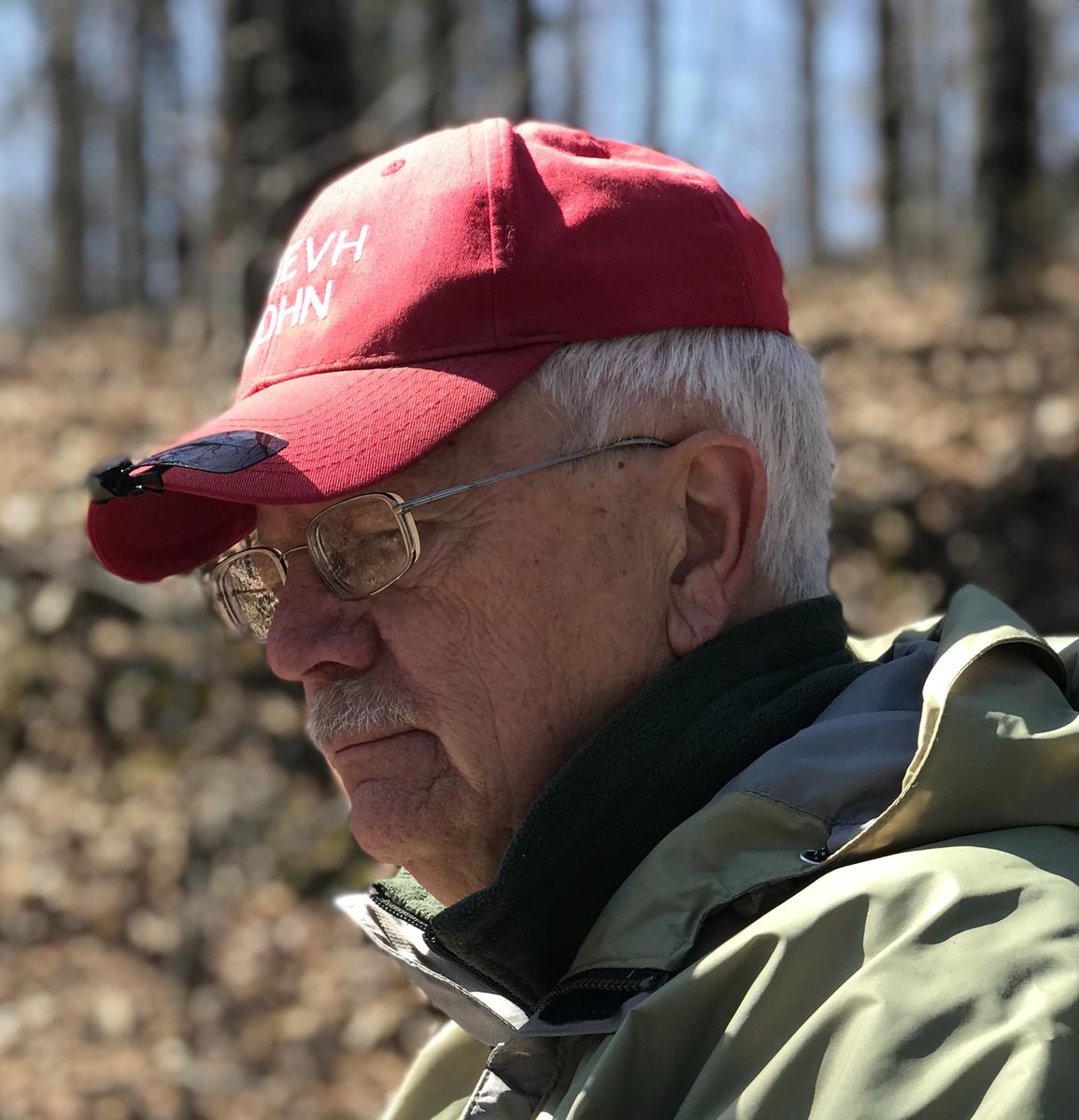
That's me NØEVH making contacts during Field Day operations June 2010 at Weston Bend State Park, Missouri. Kent KØWEW made up the second half of the 1B2B solar powered QRP station. I have been active in ham radio since high school in 1963 when first licensed as WNØGQA in St. Joseph, Missouri. My interest in radio began in the late 50's with a four foot tall Stewart-Warner shortwave receiver belonging to my stepfather. A long piece of bell wire in the attic brought stations in from all over the world. I still have a dozen or so of those "SWL" cards from Radio Australia and others dated to 1960. Soon I had a National 183 receiver and then traded up to a transistor version of the Zenith Transoceanic. Even then I was liking radios that ran on batteries. Shortwave and MW broadcast listening taught me alot about propagation on the bands. I was hearing everything, but I couldn't talk to anyone! Thanks go to two elmers who helped me homebrew my 40 meter novice transmitter, pass that scary exam and put that ugly antenna in my mom's front yard. My Heathkit HR-10 receiver was earned by painting one hams house. I never had to worry about which frequency to use on 40 meters, because I only had one crystal for the CW novice band! My transmitter was homebrewed using parts from a junked TV set with the exception of the 6146 final tube donated by my ham neighbor Max. Most everything was homebrew when you made 50 cents an hour working at the local drug store scooping icecream! As with many young hams my interest continued leading to a part time job at the local TV shop while attending college. I decided to go into chemical engineering for a profession so I could play with radio at home. Good decision. Ham radio activity was minimal during college. Graduated from the Missouri School of Mines at Rolla in 1968 with a BS in Chemical Engineering. With the Army I was trained as an 05B20 Radio Operator at Fort Knox. Served as the radio operator for a Combat Engineering Battalion. Later I upgraded my license while living in Lawrenceburg, Indiana and had callsign WB9YGX. There I helped start a new radio club and put a two meter repeater on the air, we built from an old GE Prog line transceiver. Located in Lawrenceburg, Indiana it was the first repeater in SE Indiana in 1975. Now that I have retired from 43 years in engineering I have more time for amateur radio. What other hobby teaches you about technology, geography and allows you to make friends all over the world? Can't do that with a bowling ball now can you?
I especially enjoy HF radios that I can take camping and hiking, thus my interest in battery powered gear. Nothing can match the thrill of chatting with a friend while camped in the boonies or snagging that rare DX using a piece of wire thrown in a tree. The vast majority of my on air time I use Morse code because of its effectiveness and simplicity of equipment. After all Morse is the first digital mode and is more personal than typing on a keyboard. Just me and the ionosphere bouncing my signal to some far away place.
Special thanks to Steve KØOU my CW and FD mentor. His enthusiasm for ham radio, developing Morse skills and 'playing radio' is contagious. For decades I played in big Field Day operations, but have switched to single transmitter on battery power with effective wire antennas. NØEVH Rule #1, you have to be able to setup for field day in under two hours by yourself! This forces me to simplify and optimize. Hope to meet you on the air for a chat. I could be in the shack at home, mobile, camping or hiking running pedestrian mobile. Have 33 states running HF pedestrian mobile and would like to work you from the trail. Picked up some retro ham gear recently that is fun to use. On the QRO side a mint TS-530 sugar and for QRP a very nice Heathkit HW-8. Don't tell the xyl she has not noticed them yet! Be sure to set a goal this year with your hobby of ham radio. Learn a new mode, new skill, take ham radio on an adventure somewhere, build a new radio, design a new antenna or help a new ham get on the air! With the advent of electronic logging/QSL it is easier than ever to collect new ones in the log. DXCC QRP, WAS QRP and WAS QRPp are in the book for me. Need another 20 countries for DXCC QRPp. Looking forward to a QSO with you. Title 47, Part 97 Amateur Radio Service Subpart 97.3 Definitions (4) Amateur service. A radiocommunication service for the purpose of self-training, intercommunication and technical investigations carried out by amateurs, that is, duly authorized persons interested in radio technique solely with a personal aim and without pecuniary interest. That would be me! 73 John - NØEVH Last modified: 2012-04-26 15:43:46, 5727 bytes fetched
My Friends
Does this page contain inappropriate content? If so, Report this page... |
|||||||||||||||||||||