nwaitress at local managua coffee -shop
time-keeper of the buses leaving managua for other parts of the country.
Conmemorative call for THE 350 ANNIVERSARY OF THE FOUNDATION OF THE MOSQUITO NATION .
===================================================================================
LaNación Misquita, conocida también comoMosquito Nation. Establecido comoreinodesde1661y protectorado de Gran Bretaña. En1894, el estado desaparece y se anexa a larepúblicadeNicaragua. Capital:BluefieldsPoblación: 15,000 (en 1905) Etnias:Garífuna,MisquitosyAfrocaribeños Dinastías:
Gobernantes
[editar]
first picture - Junk Yard in Managua
the first of the last two pictures showing myself onboard the riverboat just leaving San Carlos in Nicaragua bound for Los Chiles in
Costa Rica - takes about an hour .
second foto - preparing breakfast (rice & beans called gallo pinto in central america )open fire is very much in use . of course we do have
gas stove for normal cooking but at this moment we just run out of gas.
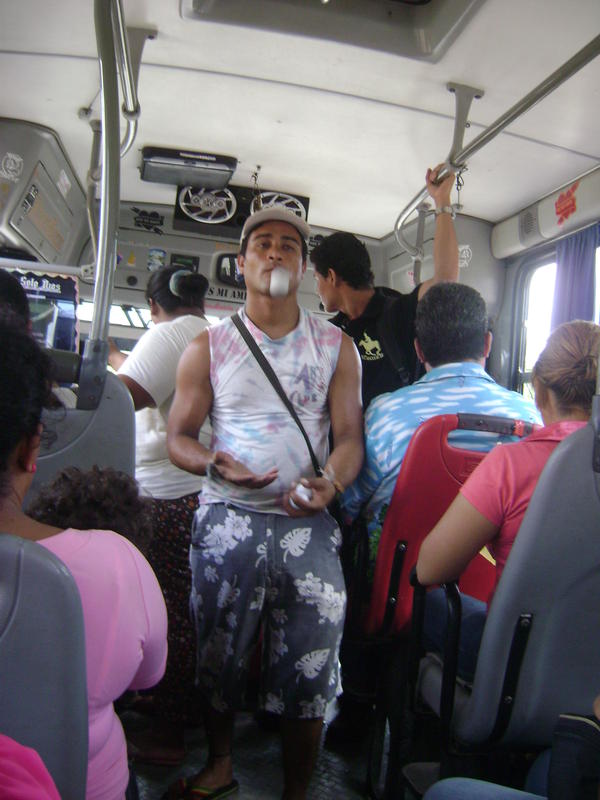
many salesmen of farmacy products - of doubtful origin - trying to sell on the buses of managua. About the Miskito People:![]() TheMiskitoPeople are Native American people in Central America. Their territory expands from Cape Cameron, Hondurous, to Rio Grande, Nicaragua along the Miskito Coast ("La Mosquitia"). [4]This area located on the northeast coast of Nicaragua and the east coast of Honduras and is made up of lowland coastal areas, savannas and rain forests. In order to survive they live as farmers and fishermen in small villages of the lowland rainforset of Nicaragua and Honduras. [1] The Miskito people most likely belonged to theChibchaculture of northern South America. They are believed to have descended from a group of Sumu who migrated northward across what is now called Panama. [1] As the Spanish settled in Nicaragua this people groupe retreated more and more towards the lowland jungles and swamps of the coast where they found refuge from the aggressive Spaniards and eventually spread into neighboring Honduras. [5] In the 1600s escaped and shipwrecked slaves sought refuge and intermarried with the Miskito people. As a result there are very few pure-bloodedMiskitotoday. [4] However, the Miskito people have preserved thier language and much of thier culture. [2] It was not untill the 1700s that the Miskito people began to have significant contact with outsiders. As the English gained greater control of the Caribbean, traders and settlers began to establish contact with the indigenous people. As they obtained muskets and ammunition from the English, they were able to conquer smaller and weaker tribes in the area. The name “Miskito” may have derived from various spellings of “musketeros” meaning “the people withmuskets”. This mixed native-African society became the Miskito people of today. [5] The British made friends of the Miskito people encouraging them to raid Spanish settlements in the south and Indian settlements in the interior, selling their captives as slaves. In an attempt to better manage them the British appointed a Miskito king and set a kingdom they could control. The British maintained control over the Miskito territory even in the 1830’s when the Central American colonies gained independence from Spain. In 1860, the Nicaragua government signed a treaty with Great Britain to control a Miskito reserve. This reserve was governed by English speaking Creoles from the southren part of the reserve. [1] ![]() During the late 1800s and early 1900s the United States began to have more direct influence over the Miskito. British and US interests established banana plantations and logging industries. These plantations and industries provided jobs for the Miskito people and caused them to become accustomed to flour, sugar, and western clothing. By 1940 the banana industry had ended because of a large-scale banana disease. As a result the Miskito people were forced to return tosubsistence farmingand poverty. [1] In 1849, German Movarian missionaries came to the Miskito people. They first convertedEnglish Creolepeople in the south. The Moravian church became the stabilizing economic, social, and political force throughout most of the region. Until the 1979Sandinistarevolution, the Nicaragua government relatively neglected the Miskito people. Conflict erupted when the Sandinista attempted to implement their socialist economic policies on the Atlantic coast. [1] Some of the Miskito people fled to Honduras and lead a resistance movement aligned with the US-backedContras. [3] If they did not flee or join the resistance movement the Miskito people were resettled by the Sandinista in the interior. In 1989 the fighting was finally over and most of the Miskito returned to rebuild their villages. Overall, the Miskito people have never truly felt controlled by the Nicaraguan government. In fact, many Miskito today don't even consider themselves Nicaraguans. [4] Today, the Miskito have faced several years of bad harvest and are facing the worst situation of poverty since the loss of the banana industry. Life style of the Miskito PeopleMiskito villages range from 3 to over 600 houses and are located along the jungle river basins. They have no streets and houses are scattered without order. Families are linked maternally and tend to live in close proximity. [1] The villages all have a bathing spot along a creek and a docking area for communal dugouts. The idea of personal property is forgein to these people; land is not owned or sold except for in the larger commercial towns. Peurto Cabezas and Puerto Lempira are two major towns that serve as communication centers with the outside world. [4] Houses built out of split bamboo or sawed lumber with roofs of thatch or riged metal are placed up on pilings. People sit, eat and sleep on the floor. Some homes have hammocks to sleep on, but this is rare. The houses have no internal walls or furniture. A cookhouse is usually attached to the primary house by a wooden walkway. [1]The basic diet of the Miskito people is rice, beans, yucca, and banana. Fish, snails, and turtles are their source of meat. Coffee andcacaoare raised in small amounts. A typical drink is made of boiled bananas andplantains. This drink is a reliable and cheap food source when there are no crops. [1] The Miskito people have adapted to European style clothing. Women wear simple dresses and men wear pants and a shirt. Children, especially boys, play naked until they are 5 or 6 years old. Most people go barefoot around the house or village and rubber boots are only used for working in fields. [1]Modern health care is non-existent for most Miskitos. Only limited medicines such as aspirin and basic antibiotics can be purchased in some community stores. There is one regional hospital in Puerto Cabezas and two small clinics in Waspam and Puerto Lempira. [1] People have to walk and travel by trucks for days to reach these medical facilities. The lack of health care is a major difficulty these people face. As a result infanct mortality is one of the highest in Central America and life expectancy is one of the lowest. [2] Drinking water is drawn from the creek or river, usually above washing and bathing sites. Clean water is not available in any villages. Few houses have latrines which contributes to poor health conditions. [1] Governmental schools exist only in larger communities. [2] The government attempts to provide a bilingual education. All children must learn Spanish by the third grade. Secondary education is available only in four larger population centers. Classes are larger and teachers are poorly trained. Despite these opportunites, many children do not attend due to financial hardships. [1] Historically the Miskito poepled once hunted green turtles in teh context of a traditional subsistene economy. [4] They combined turtle fishing with hunting, agriculture, gather, and fishing. However, this hunting of turtles along with game hunting in general is becoming less common. Many Miskito are begining to work in the mines and in the lumber industry. [1] They continue to raise crops in order to sell or trade them for other goods. The agricultural plts are tended by women while the men clear the plots ahd hlep with the planting and harvesting. The men also have traditionally been the hunters and today are the ones taking labor jobs. [1] Worldview [2]
two sales-girls of home-made owen-made corn-products at bus-terminal of nueva guinea raas. yn4
for more fotos - yn 7 su yn 4 su h 74 leon h 7 aLast modified: 2012-08-29 17:43:52, 25682 bytes cached
This user has no active logs
Does this page contain inappropriate content? If so, Report this page... |
|||||||||||